
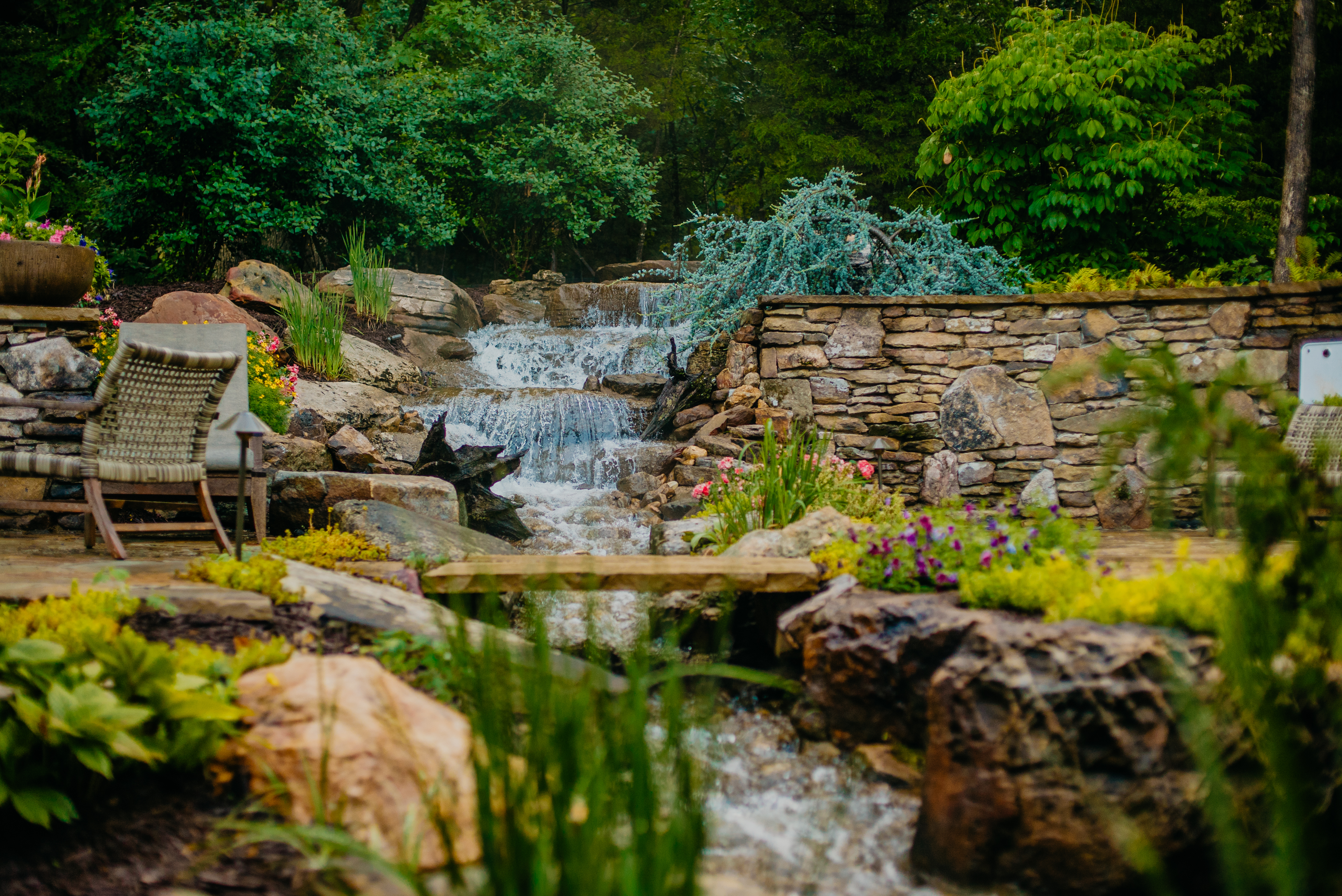
As designers, we’re often asked how to make a space feel more intentional. Clients often expect the answer to be complex but one of the simplest, most powerful tools in a designer’s kit is the strategic use of specimen plants. Specimens are those standout trees, shrubs, or perennials that anchor a space and instantly give it character.
A specimen plant is more than something pretty; it’s a focal point with intention. In professional design, every landscape needs visual hierarchy. Without it, the eye wanders and the space feels unsettled. A specimen provides that immediate organizing force. The right specimen can define a space and provide an anchor point to build the rest of the landscape around.

Choosing the Right Specimen Plants
The biggest misconception is that a specimen must be exotic or expensive. In truth, the right specimen is simply the one that creates impact. It could be a sculptural Japanese maple, a tasteful topiary evergreen, or even a common viburnum pruned in an eye-catching fashion. The key is distinctiveness: unusual form, striking texture, seasonal interest, or simply a strong emotional connection to the client.
When selecting specimens, I consider three questions:
- Will this plant hold visual weight all year? Great branching or evergreen structure matters.
- Does it fit the scale of the space? Oversized plants overwhelm; compact forms can be just as dramatic.
- Does the plant reinforce the design concept? Clean lines call for architectural species; woodland spaces thrive on soft textures.
Enhancing Architecture Through Planting
One of the most effective—yet often overlooked—uses of specimen plants is to highlight architectural features of the home. Pros use plants almost like lighting or framing elements.
A sculptural conifer can emphasize a modern home’s angular rooflines, echoing its geometry. A multi-stem tree with an airy canopy can soften a tall façade while drawing attention to beautiful stonework or an entryway. Even a strategically placed evergreen can balance asymmetries in the house’s structure, visually grounding the architecture.
Designers often use specimens to create a living frame around key features: an arching tree near a picture window, or an upright shrub pulling the eye toward an impressive front door. The goal isn’t to hide the house—it’s to harmonize with it, giving the architecture a stronger presence in the landscape.
Placement Is Everything
Professionals rarely “scatter” specimens. We place them with purpose:
- At pivot points where paths turn
- As visual destinations
- In negative space, where their form can stand alone
- Along architectural sightlines, echoing or enhancing the home’s shape
Less Is More
Too many statement plants compete with one another. One or two well-chosen specimens, supported by simpler plantings, create clarity and sophistication.
The Power of One
A single, thoughtfully placed plant can do more to elevate a landscape—and even the home itself—than a dozen impulse buys. That’s the quiet secret the pros rely on: sometimes the entire design hinges on one unforgettable plant.